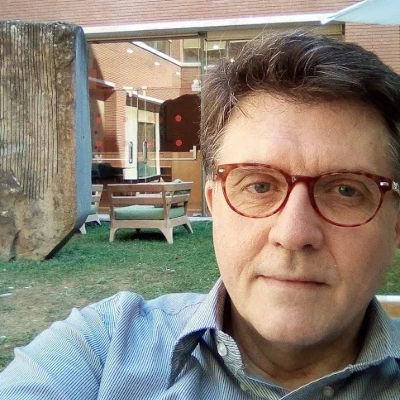
Cristoforo Prodan
Nerd Stuff & Smart Thinking
This site grows out of a path that crosses science, music, books, computing, translation and digital culture: different worlds, yet bound together by the same interest in how ideas take shape, become tools, and circulate through technologies, languages and people.
I belong to a generation that experienced from within one of the major cultural transformations of the late twentieth century: the shift from the computing of large data-processing centres to personal computing. I began using and programming computers in the age of the Commodore VIC-20, the Commodore 64 and the first IBM PCs, when one’s relationship with the machine was still direct, hands-on, almost physical.
My passion for computing, however, grew out of an earlier background: my studies in Physics at Sapienza University of Rome, with a curriculum oriented towards mathematical physics. In those years I encountered an intellectual environment shaped by figures such as Carlo Bernardini, Lucio Lombardo Radice and Sergio Doplicher, and by an idea of science as a discipline of thought, critical freedom and cultural responsibility.
That formation gave rise to a lasting interest in formal languages, in the logical structure of problems, and in the way an abstract idea can become a procedure, a program, a tool. I worked with the languages available at the time — Basic, Fortran, Pascal, dBase — and followed with growing curiosity C, Unix, networks, operating systems and the technologies that would go on to shape the contemporary digital world.
My points of reference in computing have included, among others, Donald Knuth, Brian Kernighan, Dennis Ritchie, James Gosling, Ward Cunningham, Peter Norton and John Socha: very different people, yet united by an idea of computing as rigorous craft, writing, design, elegance and usefulness. In their books, code, websites and notes, I have always recognised an aesthetics of clarity: the essential form of things built to work and to be understood.
From computing to music
My professional encounter with music came through music publishing: first on the commercial side, and later through production, planning and cultural work. I have worked with publishers, distributors, booksellers, musicians, teachers, institutions, record labels, catalogues, repertoires and teaching materials. Along the way I learned that a score is not merely a publishing product: it is a technical, historical and symbolic object; an interface between the composer’s thought, the performer’s gesture and cultural memory.
My encounter with Ut Orpheus Edizioni and with the world of early music brought me closer to historically informed performance, musical philology, the transmission of repertoires and the relationship between sources, performance practice and interpretation. It was a decisive passage: music not simply as a repertoire to be sold or catalogued, but as a living form of knowledge.
Over time I have moved through many aspects of the sector: specialist retail, distribution, international relations, import, catalogue production, promotion, marketing, technical and music-related translation, the planning of cultural initiatives, e-commerce, and web tools for trade and documentation. This plurality has given me a concrete view of how culture circulates: through books, catalogues, people, institutions, technologies, physical places and digital networks.
The Auditorium as a cultural observatory
The bookshop of the Auditorium Parco della Musica “Ennio Morricone” in Rome has also been, for me, a privileged observatory on contemporary cultural life. In that place I was able to see at close range the interweaving of music, literature, science, cinema, philosophy, public scholarship and live performance.
I attended a great many concerts, especially of classical and contemporary music, as well as meetings with leading figures in the culture of our time: composers, performers, writers, scientists, philosophers, filmmakers and public intellectuals. Some names — Karlheinz Stockhausen, Frans Brüggen and many others — remain linked for me not only to memorable events, but to the direct perception of an age in transformation.
In my own small way, I breathed the spirit of a historical passage: from analogue culture to digital culture, from the printed catalogue to the database, from the specialist bookshop to e-commerce, from linear writing to hypertext environments, up to the current age of generative artificial intelligence.
Nerd Stuff & Smart Thinking
Nerd Stuff
For me, “nerd” does not mean escaping from reality, but looking at it closely: taking problems apart, understanding how things work, respecting details, and looking for unexpected connections between distant domains. A source file, a Bach fugue, a typographic table, a bibliographic database, an operating system, a well-resolved translation or a clean web page ultimately belong to the same family: objects built with logic, imagination and discipline.
Smart Thinking
“Smart thinking” means using tools without becoming their prisoner. This applies to computing, publishing and translation, and today also to artificial intelligence. Every technology carries both a promise and a risk: it can broaden our capacity to think, but it can also oversimplify, automate judgement and produce noise.
I use AI as a working environment for writing, research, prototyping and revision: to write better, translate with greater control, explore technical solutions, design websites, organise documents and test hypotheses. But I continue to regard human oversight, editorial competence, source checking, quality of language and a sense of proportion as decisive.
What I work on
Music and publishing
Music publishing, scores, books on music, music education, catalogues, distribution and musical culture.
Translation and writing
Translation from English, music-related texts, essays, manuals, reviews, articles and cultural documentation.
Web and software
Websites, CMSs, HTML5, Bootstrap, PHP, JavaScript, Python, SQLite, GNU/Linux, LaTeX, LilyPond and open-source tools.
AI and digital culture
Reflective use of artificial intelligence for research, assisted translation, revision, prototyping and work organisation.