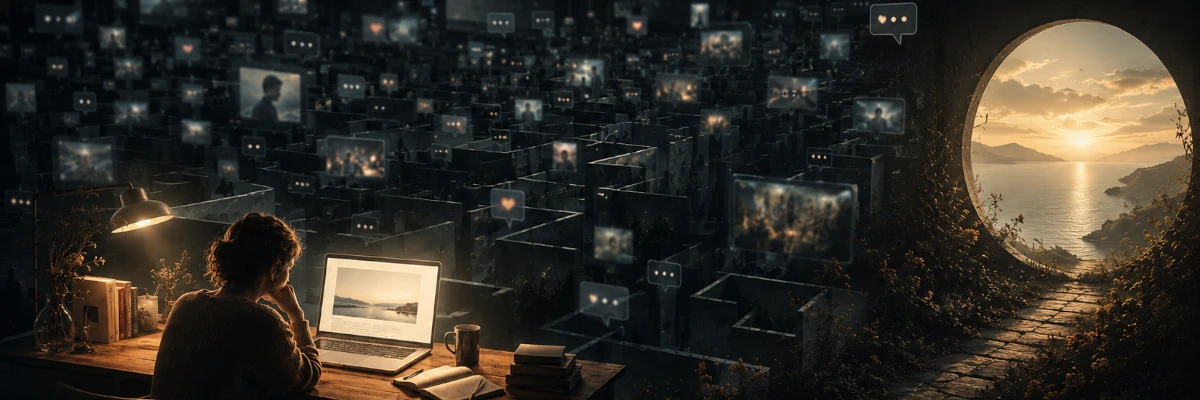
The first post of a blog could very well begin with the best-known and most historically charged test phrase in the world of computer programming: hello, world. Tradition has it that it was originally written strictly in lowercase, as in one of its early appearances in Brian Kernighan and Dennis Ritchie’s celebrated 1978 book The C Programming Language, where it appeared as the output of the first and simplest program written in that language. It became a kind of initiation rite for programmers: proof that something works, that the language responds, that the screen does not remain silent.
And yet the question is unavoidable: what sense does it make to start a blog in 2026?
This is not a rhetorical question. We live in a time when artificial superintelligence is already being discussed in prophetic, or apocalyptic, tones; when authoritative, or at least influential, scenarios place the surpassing of many human capabilities by machines within the span of just a few years; when entire generations have never known the web as an open place, but only as a sequence of platforms, apps, notifications, profiles, algorithms, and more or less elegant walls.
For many, “being online” means being inside a social network. For others, it means chasing content through environments designed to keep us there for as long as possible.
In this landscape, a blog seems like an ancient thing. An object out of time. A small workshop on the outskirts of the digital city, while the traffic has moved into the shopping malls of the major platforms. And yet it is precisely this apparent untimeliness that now seems to me to be its reason for existing.
The open web was never a paradise. Blogs, too, had their vanities, their small narcissisms, their illusions of centrality. A blog, too, can give the impression of speaking into the void. Here as well, one can write without being read, or be read by very few. The difference, however, is not insignificant: a blog belongs, at least in part, to the person who writes it. It has an address, an archive, a stable form. It does not live only in the stream. It does not necessarily ask to become fuel for someone else’s advertising machine. It does not turn every sentence into bait for measuring reactions, retention, and polarization.
Over time, social networks have become a "hall of mirrors". They give the illusion of being read, heard, discussed; more often, they produce rebounds, reflections, distortions. Content almost never matters in itself, but for its ability to generate an immediate response: approval, outrage, sarcasm, insult, pedantic correction, deliberate misunderstanding. Everything must become conversation, and conversation must become entertainment. Even dissent is monetized. Even nausea becomes engagement.
To avoid this mechanism, the blog will be closed to comments. Not out of contempt for the reader, but out of respect for writing. Not because dialogue does not matter, but because not every space must be turned into a shouting square. I have seen enough hyper-commenters, enough professional insulters, enough discussions that began with a sentence and ended in a reckoning among strangers. The technical possibility of commenting is not, in itself, a democratic value. Sometimes it is merely the opening of a breach in the floor.
In this, I take comfort from an illustrious precedent. In October 2010, Ursula K. Le Guin, at the age of eighty-one, began a blog. She was certainly not a writer in search of visibility. She had already written books destined to outlast any digital platform. And yet she chose that form, taking inspiration from the blog of José Saramago, who in turn had begun publishing online in 2008, at the age of eighty-five. Two elderly writers, two immense authors, two people who had nothing to prove to anyone, used the blog as a space of freedom: thoughts, observations, notes, detours, moral and political interventions, but without the obligation to turn every page into an arena.
I like this idea: the blog not as a megaphone, not as an adolescent diary, not as a substitute for social media, but as a public notebook. Public, but not interactive at all costs. Open to reading, not surrendered to permanent interruption.
I have in my hands the first Italian edition of blog!, the book by David Kline and Dan Burstein, originally published in 2005 and released in Italy in 2006. Rereading it today, twenty years later, has a strange effect. Many pages seem to be speaking about the present; only the words have changed. Where one once said “blog”, today we might say “social media”, “platforms”, “artificial intelligence”, “content creators”, “disintermediation”, “algorithms”. That book described the enthusiasm for a new form of communication from below, the possibility of bypassing traditional media and editorial hierarchies, the birth of a public that no longer wanted to be merely a public.
Then something happened. I do not know whether there is a precise date for the death of blogs, at least blogs as a mass phenomenon and as a genuinely interactive space. Perhaps they never died completely. Perhaps they simply went out of fashion. But a symbolic threshold can be located in the years when Facebook, Twitter, and the other platforms absorbed the logic of the feed and transformed it into a closed, centralized, proprietary environment.
Before that, there were mailing lists, forums, RSS feeds, aggregators: imperfect tools, often technical, sometimes inconvenient, but based on the idea that the reader should choose what to follow. Then came the algorithmic stream: no longer “I follow this site”, but “I stay here and see what the platform decides to show me”.
It was a revolution, and an extremely convenient one. And that is precisely the problem. Convenience has a price. The price is accepting rules we did not write, censorship or arbitrary decisions we cannot control, interfaces that change without consulting us, audiences that do not belong to us, archives that can disappear, content that is promoted or buried according to opaque criteria. The price is exchanging the freedom of the web for the conditional visibility of platforms.
Starting a blog in 2026, then, is not a nostalgic gesture. Or at least I would not want it to be. This is not about pretending that 2005 can return. It will not return, and perhaps that is just as well. But some of the ideas of the web of that time deserve to be recovered: slowness, the archive, the link, personal responsibility for the page, the possibility of reading without being immediately called upon to react, the possibility of writing without having to optimize every sentence for an algorithm.
A blog is also a way of escaping the tyranny of the immediate. Here, a text can remain, can be found again, can age well or badly, but at least it ages in a recognizable place. It is not swallowed after a few hours by a stream designed to forget.
This space is therefore born as a small “back to the future”. Not a refuge from the present, but an attempt to inhabit it differently. There will probably be notes, readings, music, books, technology, translation, scattered observations, perhaps a few useless but necessary digressions. I do not promise regularity, I do not promise absolute coherence, I do not promise topicality.
I promise only one thing: that this will be a space of my own, readable by whoever wishes to read it, without the ambition of chasing the compulsory conversation of the day.
hello, world, then. Not because the world was waiting for this greeting. But because every new environment, before becoming anything else, must at least prove that it can speak.